Research Overview
Decoding Lagoon Dynamics
Visualization of the environmental forces that drive larval dispersal in the lagoon ecosystem surrounding Mangareva and Aukena Islands, in French Polynesia.
This project is an interactive simulation and interface prototype designed to approximate the larval dispersal of the black-lipped pearl oyster (Pinctada margaritifera) within the lagoon ecosystem surrounding Mangareva and Aukena Islands, in French Polynesia. It was developed as an information design exploration for the course Art + Media Studio – Information Design at Aalto University.
CONTEXT Pearl farming is a multi-year aquaculture practice relying on the natural lifecycle of the marine oyster. The farming cycle begins with 'spat collection', where farmers place artificial lines of collectors into the water to catch free-floating oyster larvae—known as spat—just as they are ready to settle and attach to a surface. Once these juvenile oysters are collected, they are raised on underwater farms until a skilled technician surgically inserts a small nucleus, which the oyster eventually coats with nacre—or mother-of-pearl—to form a pearl.
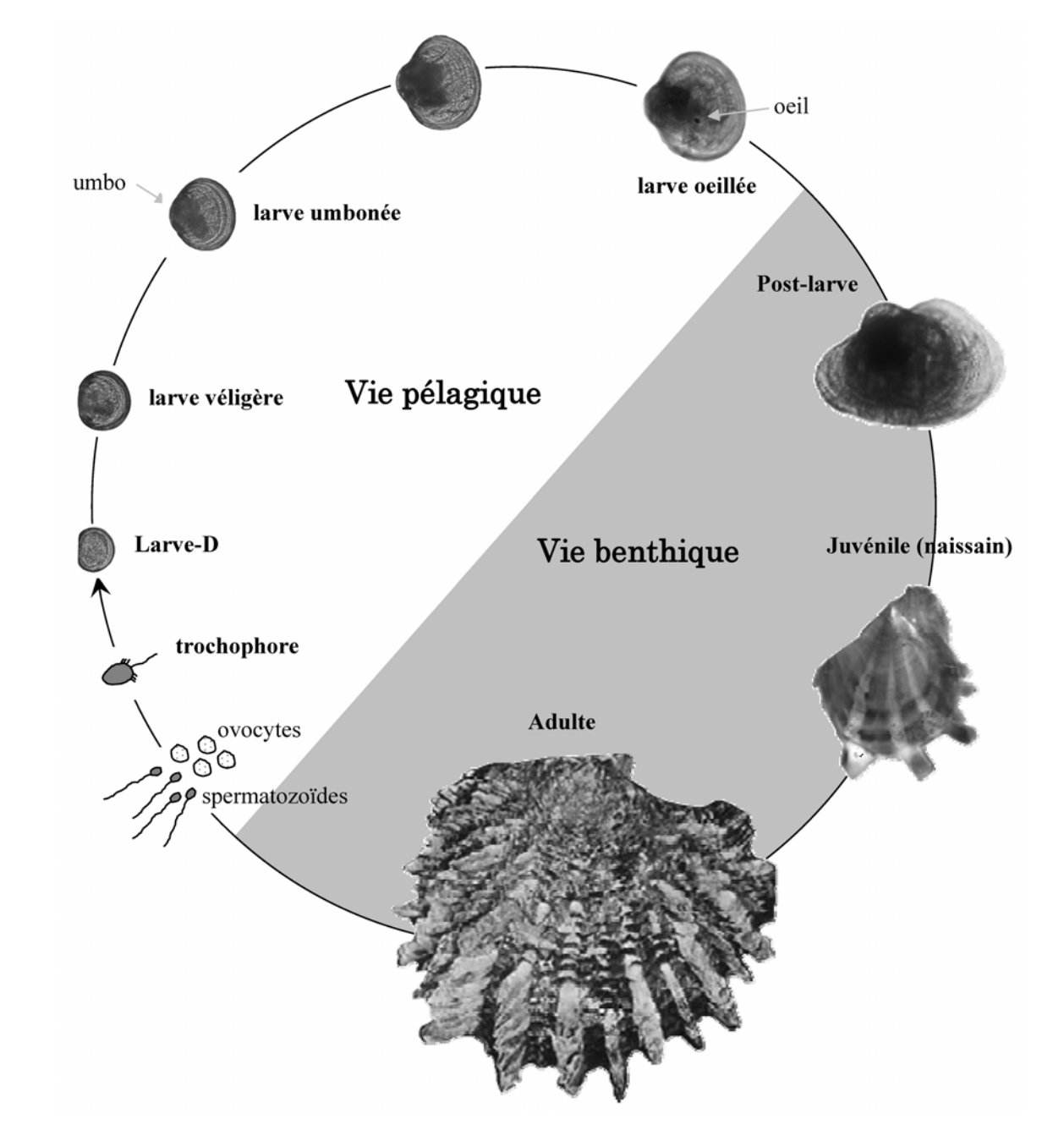
Note. Reprinted from Écologie larvaire de l'huître perlière (Pinctada margaritifera L.), croissance et dispersion dans un lagon d'atoll polynésien (p. 8), by Y. Thomas, 2009, Doctoral dissertation, Université de Bretagne Occidentale.
In French Polynesia, this industry centers on the black-lipped pearl oyster, producing the region's famous and highly valued black pearls. Pearl farming is the second largest source of income, right after tourism, providing critical local employment and sustaining the socioeconomic stability of coastal communities. Within this territory, the Gambier Islands have historically been one of the most vital hubs for the industry, representing 25% of French Polynesia's black pearl production in 2020.
PROBLEM For decades, the Rikitea sub-lagoon in Gambier enjoyed highly stable natural spat collection, providing a steady supply of juvenile oysters. However, since 2018, this mechanism has collapsed into a severe 'recruitment crisis'. This decline is largely driven by climate change and wind instability, along with rising sea surface temperatures that alter the lagoon's hydrodynamic conditions. In practical terms, environmental changes physically prevent oyster larvae from remaining in their traditional harvesting areas long enough to be harvested, thereby affecting local pearl production.
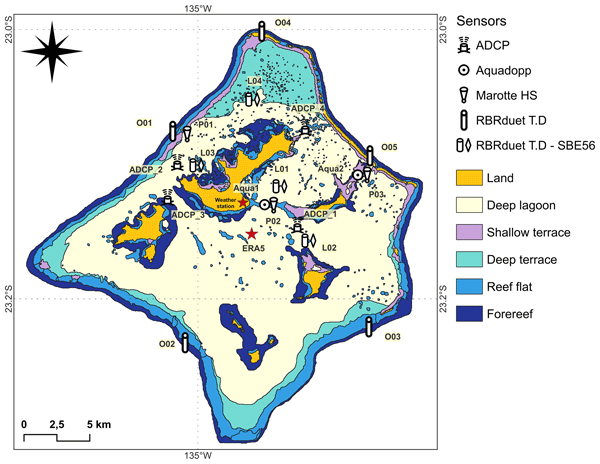
Note. Reprinted from Lagoon hydrodynamics of pearl farming islands in French Polynesia : the case of Gambier Islands [Data set], by S. Andréfouët, O. Bruyère, V. Liao, and R. Le Gendre, 2023, SEANOE. https://doi.org/10.17882/94148
SIMULATION & INTERFACE LOGIC The simulation combines empirical environmental data with a rule-based behavioral model of larval movement. Oceanographic inputs such as currents and temperature are derived from measured sensor data collected during a 2019–2020 campaign, while larval behavior is computationally modelled as a simplified approximation of biological processes.
The simulation models larval dispersal in the lagoon over a fixed historical period (late October 2019 to late February 2020), displaying the lagoon as a spatial map with animated current patterns and larval movement over time. In the map, up to five artificial larval collectors can be placed at different locations within the lagoon to show how larval presence and movement vary across space and time in relation to environmental conditions such as currents and temperature. The placement of collectors determines how many larvae are captured at each location during the simulated period.
The system enables the exploration of spatial and temporal variability in larval distribution under consistent environmental conditions.
Simulator
Collettors (Max 5)
Place a collector in the lagoon. Click it to remove.